
 Water
Water IRS
IRSHome / Illinois
 Illinois service
Behind on your Comptroller annual financial report? We prepare every late year for a fixed price.
Each late annual financial report for fiscal 2025 or later can draw a fee of up to US$20 a day, and the Comptroller can order an audit of a unit whose reports stay unfiled and send it the bill. We prepare the report for every late year from your bank statements and treasurer's records. Your officer reviews it, signs and files. We invoice after delivery.
For Illinois townships, villages, cities and fire protection, park, library, road, sanitary, water and other districts. Send your unit's name or Comptroller unit code.
The Comptroller's late list
local governments on the Comptroller's late list dated October 13, 2026.
late reports between them, some going back to 2001.
units with three or more reports late.
is what the daily schedule in the law adds up to on the 499 late reports for fiscal 2025 and later, before any reduction.
Our count from the Illinois Comptroller's list of delinquent local government reports, dated October 13, 2026. How the fees add up
Late fees
What a late report can cost
The law lets the Comptroller charge a fee for each late report: US$5 a day for the first 15 days past due, US$10 a day for days 16 to 30, US$15 a day for days 31 to 45 and US$20 a day from day 46. The amounts may be reduced at the Comptroller's discretion. The law calls them fees; the Comptroller's notices call them fines.
| Days past due | Fee so far |
|---|---|
| 15 days | US$75 |
| 30 days | US$225 |
| 45 days | US$450 |
| 60 days | US$750 |
| 100 days | US$1,550 |
| 180 days | US$3,150 |
| One year | US$6,850 |
Five things that move the number
- Per report, per fiscal year. A unit that owes both its annual financial report and its audit for one year can draw two fees, and each late year adds up on its own.
- Fiscal 2025 and later only. The Comptroller's fines FAQ says the fees apply to fiscal 2025 reports and every year after. Older late reports carry no daily fee, but they stay on the public list.
- The clock starts the day after your due date. The report is due 180 days after your fiscal year ends, or 240 days if you ask for the 60-day extension in Comptroller Connect before you submit. Filing in the extension window without asking still draws fees from day 181.
- It stops only when a compliant report is received, in the Comptroller's words. A rejected report or a draft upload loses its received date, and the fees keep running.
- It may be reduced after you file. The Comptroller's office sends instructions for asking for a reduction after the report is in, and asks units to wait for them.
How you hear about it
The Comptroller sends three fine notices. The first comes about 3 months after your due date, or about 1 month after your final due date if you had an extension; the next two follow a month apart. After the third notice, the fine is certified as a debt owed to the Comptroller's office.
Bigger than the fee: an audit you did not order
If a report is still not filed by the date in the Comptroller's written notice, the law says the Comptroller shall have an audit made, and the unit pays the auditor's actual compensation and expenses. The Comptroller may decline when the books are inadequate or unavailable, or the cost would be an unreasonable burden. Either way, the unit stays on the list until it files.
The same schedule appears in four laws: 50 ILCS 310/4(c) for townships and districts, 65 ILCS 5/8-8-4(d) for cities and villages, 65 ILCS 5/8-8-3.5 for TIF reports and 55 ILCS 5/6-31004(c) for counties. Comptroller, Fines: Frequently Asked Questions (PDF). Checked October 13, 2026. Every fee figure on this site is an estimate, before any reduction.
Who files
Which units owe the report, and under which law
Every unit files one annual financial report in Comptroller Connect, due 180 days after its fiscal year ends. Drainage districts and school districts do not file it with the Comptroller. The counts below are the units on the October 13, 2026 late list.
| Unit type | On the late list | Law that requires the report | Audit rule through fiscal 2026 |
|---|---|---|---|
| Villages, cities and incorporated towns | 139 villages, 27 cities | Illinois Municipal Code, 65 ILCS 5/8-8-3 | Population 800 or more, bonded debt or a utility: audit every year plus the report. Under 800 with no utility and no bonded debt: the report only. |
| Townships | 133 | Governmental Account Audit Act, 50 ILCS 310 | Revenue under US$850,000: an audit every 4 years, or a 3/5 board vote with no audit. At or above: audit every year plus the report. |
| Fire protection, park, library, road, sanitary, water and other districts | 55 fire protection, 29 park, 10 water service, 8 library, 8 road, 7 sanitary, 3 port, 3 public water and others | 50 ILCS 310 | As townships |
| Counties | 14 | Counties Code, 55 ILCS 5/6-31003 | Audit every year by a CPA, plus the report |
The four shapes of the report
One online form, four shapes
There is no separate paper form per unit type. The screens your unit sees in Comptroller Connect depend on its type and its answers to the registration questions, which is why we decide the shape for each late year before entering a single figure.
Shape 1
Verification of Appropriation
For a special purpose district whose total appropriation or budget is at or under the year's threshold (US$9,630 for fiscal 2025). Contact details and the appropriation figure, then submit.
Shape 2
Abbreviated form
For a special purpose district with total revenue under US$100,000 that keeps cash-basis books with no assets. Revenue, spending, fund balance and debt in three columns. No assets page.
Shape 3
Full report, no sub-accounts
Every other special purpose district: fire protection, park, library, road, sanitary, water service and so on. All registration steps and all financial pages, by fund type.
Shape 4
Full report with sub-accounts
Cities, villages, incorporated towns, townships and counties, with the sub-accounts the unit ticks. Cities and villages also answer the home rule and TIF questions.
What the full report asks for
- Registration: contacts with three separate government emails, each validated; purchasing agent and FOIA officer; fiscal year end; accounting method, debt, utilities and pensions; population and equalized assessed valuation; employees and salaries; funds and component units; appropriation
- Assets, liabilities and equity at year end (codes 101 to 145, or 101 to 155 for GASB 34 units)
- Revenue by source (codes 201 to 240) and spending by function (251 to 280), each by fund type
- Fund balance (301 to 310), indebtedness (400 to 423), debt limits, pensions (500 to 505) and optional capital outlay
- Audit requirement, explanations for any "other" figure or difference, then submit
Rules that catch units out
- Whole dollars only: no commas, dollar signs or cents. Click Add/Update on every page, and accept each total with "Yes".
- A draft upload is not a filed report. Its received date is removed and fees run from the due date.
- The Comptroller has 45 days to review. A reopened report stays open for only 2 business days.
- Each fiscal year is its own login and its own report. File the oldest first.
Comptroller Connect Instructions, fiscal 2025 and 2026 editions; our note on filing without a rejection
Fiscal 2027
The audit-in-lieu line rises from US$850,000 to US$1.4 million
Public Act 104-635 (Senate Bill 2836) took effect July 24, 2026. Beginning with fiscal 2027, a township or district under the Governmental Account Audit Act with revenue under US$1.4 million may skip the yearly audit and choose one of two routes. Units at or above the line keep the yearly audit and also file the report. Before fiscal 2027, including any late years you are catching up, the old US$850,000 line applies.
Option 1
An audit every 4 years
The unit has an audit made at least once every 4 years by a licensed CPA, and files the annual financial report every year.
Option 2
A board vote every year, no audit
A copy of the report goes to each board member, it is presented at a public meeting, in person or by live phone or web connection, and the board approves it by a 3/5 majority vote. A Certified Copy of Vote goes in with the report.
| Fiscal year ends | Report due | With extension |
|---|---|---|
| March 31, 2027 | Sept. 27, 2027 | Nov. 26, 2027 |
| April 30, 2027 | Oct. 27, 2027 | Dec. 26, 2027 |
| Dec. 31, 2027 | June 28, 2028 | Aug. 27, 2028 |
The Comptroller's own example labels a fiscal year by the year it ends, so fiscal 2027 is the year that ends during 2027.
The vote document has to be right
The Certified Copy of Vote is the Comptroller's own form. It must show the unit's name and code, the fiscal year, that the report was approved by a 3/5 majority vote, the date, and the signature of the official record keeper (the township clerk, or the FOIA officer for a district), with a notary seal or the unit's official seal. Approval can take up to 5 business days, and a faulty form is rejected with the report, while fees run.
Cities, villages and incorporated towns follow the Municipal Code instead. From fiscal 2027, under P.A. 104-167 and P.A. 104-852: under 1,000 people with no utility and no bonded debt, the report only; under 1,000 with a utility or bonded debt, the report every year and an audit every 4 years; 1,000 or more, an audit and the report every year. Counties still audit every year. Read the full note on the fiscal 2027 change.
What you get
Three services, one way of working
Most units start here
Catch-up
US$2,000 to 4,500
- The annual financial report for up to three late years, from your records
- Totals checked against your bank statements
- Filing notes for Comptroller Connect, year by year
- A one-page fee statement for your board
- Longer gaps quoted after the free statement
Every year after
Yearly report
US$600 to 1,800 a year
- A reminder and records checklist well ahead of your due date
- The report prepared and checked against your bank statements
- Filing notes, and the last day to ask for the 60-day extension
- Cancel any year by email
From fiscal 2027
Audit-in-lieu package
US$1,000 to 2,500
- For units under US$1.4 million whose board chooses to file the report instead of a yearly audit
- The fiscal 2027 annual financial report
- A plain one-page summary for each board member
- The Comptroller's Certified Copy of Vote checklist and a timeline so the vote and its approval land before your due date
What you get back, for each year
- A figures sheet: every number and answer in the order the Comptroller Connect screens ask for them, with the record each comes from
- A note of how each total ties to your bank statements
- A plain filing guide for the officer who submits, from login to the county clerk's copy
- A list of anything your records could not settle, with what we assumed and why, to read before you file
- Your next due dates, including the last day to ask for the extension
- After you file, if the Comptroller sends reduction instructions: a letter template you can adapt and send in your own name
We do
- Prepare each report from your records
- Check every total against your bank statements
- Write the filing notes
- List what is missing, and the simplest way to get it
- Keep a calendar of your due dates
We do not
- Audit. That is a licensed CPA's work, and we are not a CPA firm.
- Log in as you. Your officer keeps the login and submits.
- Decide your audit route, or draft a motion, resolution or ordinance.
- Ask the Comptroller to reduce your fees. That request is yours.
Sample statements
Real statements, built from the Comptroller's late list
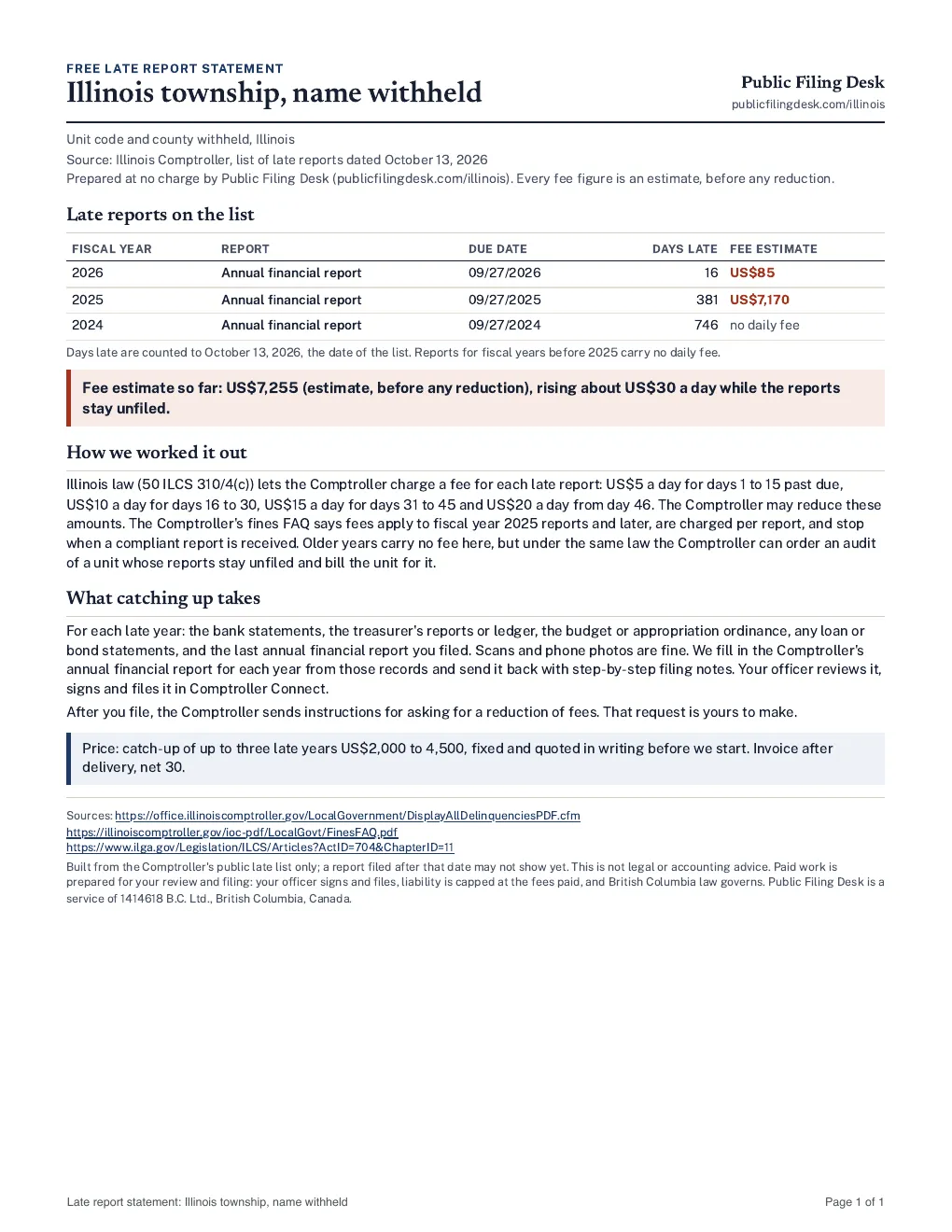
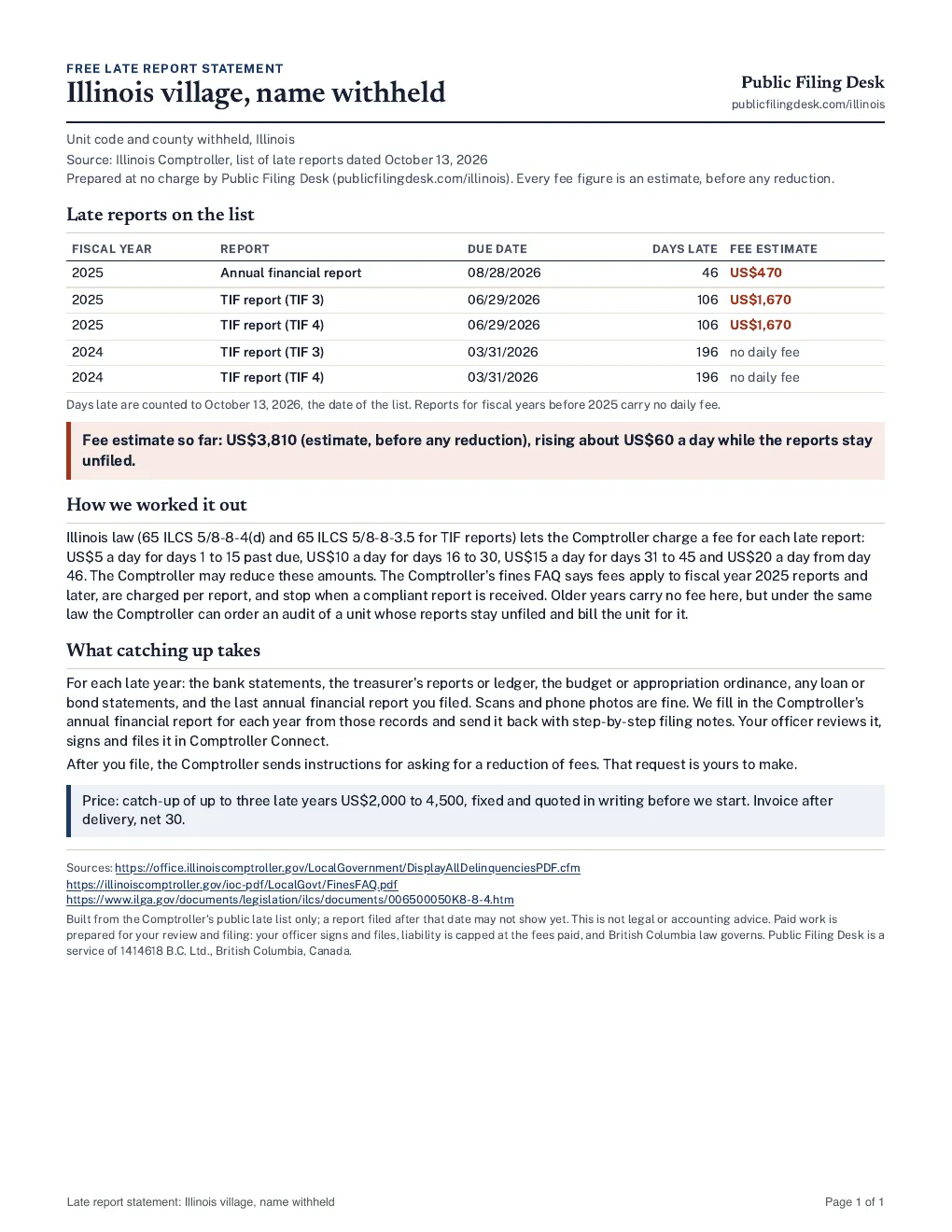
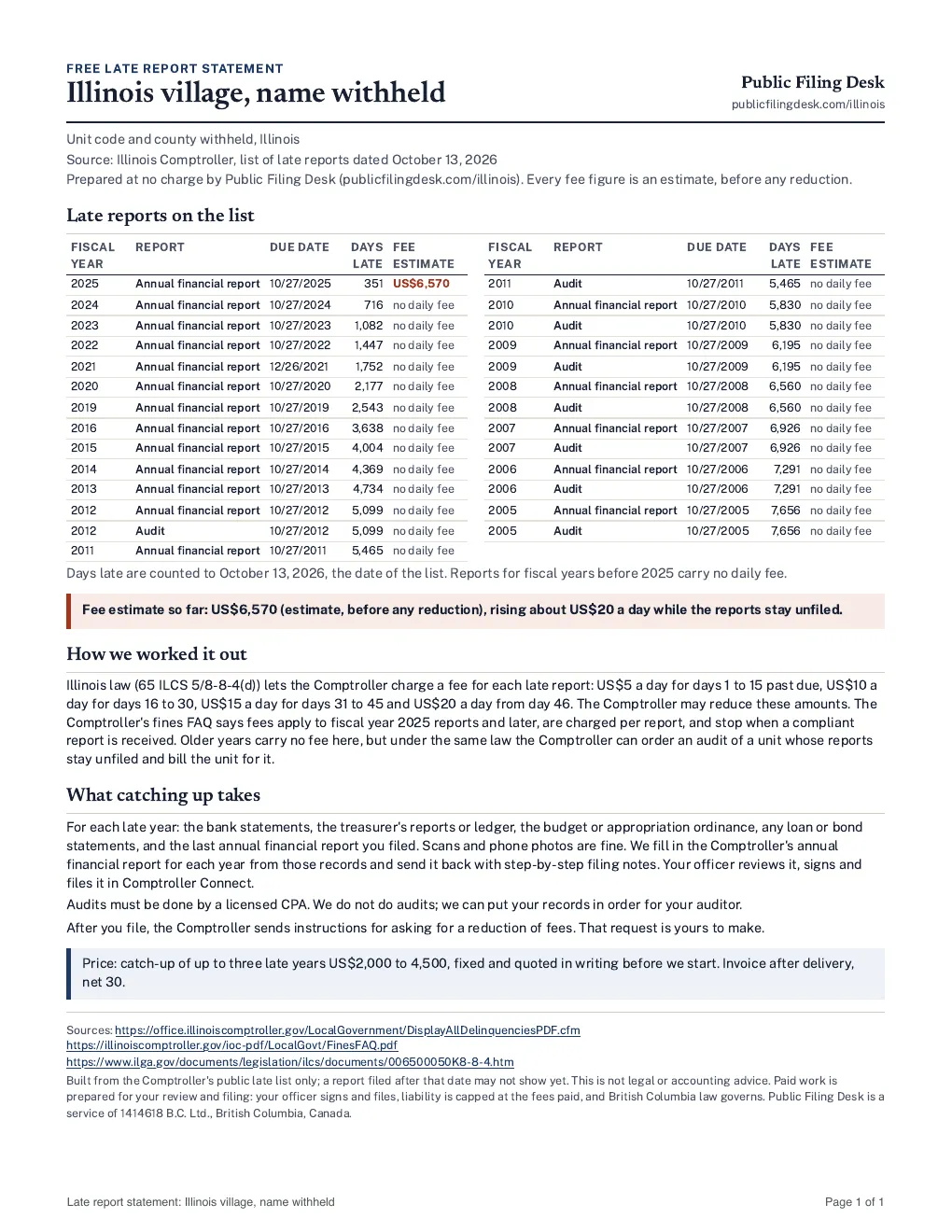
Three of the free one-page statements we prepared from the list dated October 13, 2026, with each unit's name, code and county removed. The late reports, days late and fee math are real. Yours looks the same.
What we need from you
For each late year, the paper your treasurer already keeps
These follow the documents the Comptroller's own filing instructions tell units to have ready. Scans, phone photos and exports from your accounting software are all fine.
What we never ask for
Your Comptroller Connect login, online banking logins, anyone's Social Security number or individual pay records. Payroll totals are enough.
- Your unit's name, Comptroller unit code and fiscal year end, and the officer who will file.
- Bank statements for every account, all 12 months, plus the first month after year end. Include savings, money market, CD and Illinois Funds statements.
- The treasurer's report, ledger or check register. From QuickBooks or similar: the general ledger, income statement by fund and year-end balance sheet.
- The appropriation or budget ordinance, with amendments, and the tax levy ordinance.
- Payroll totals, such as the W-3, and the number of people paid on a W-2.
- Loan, bond or lease-purchase papers and year-end balances, if any.
- Grant award letters, ordinances creating special funds, and large purchases in the year.
- Your IMRF GASB 68 report, if you take part in IMRF, and the billing summary if you run a utility.
- The last annual financial report you filed, if you have it. If not, we pull it from the Comptroller's public warehouse.
Process
From the late list to a filed report, by email
No visits, no software to install and nothing to pay up front.
Free statement
Within 2 business daysEmail your unit's name or code. You get a one-page statement built from the Comptroller's public list: each late report, its due date, days late and the fee math so far.
Fixed quote
On requestA one-page quote and scope with a fixed price and a delivery date, addressed to your board if it must approve the spend.
You send records
Your paceFor each late year, the records listed above. We ask follow-up questions by email, and if a year cannot be rebuilt from what exists, we tell you before we start.
We prepare each report
Days once records are completeWe decide the report's shape for each year, fill in every figure from your records, tie the totals to your bank statements and write the filing notes in screen order.
Your officer files
Oldest year firstYour officer reads the assumptions list, enters the figures in Comptroller Connect and submits, then files a copy with the county clerk. You keep the login the whole time.
Invoice, net 30
After deliveryPay by ACH or check within 30 days. If the Comptroller returns a report for a reason inside our work, we fix it free. With the yearly service, we remind you ahead of your next due date.
Pricing
Fixed prices, quoted in writing before we start
| Service | Price |
|---|---|
| Catch-upUp to three late years, one fixed-price job | US$2,000 to 4,500 |
| Yearly reportThe current year, done before it is due | US$600 to 1,800 a year |
| Audit-in-lieu packageFiscal 2027 and after, under US$1.4 million | US$1,000 to 2,500 |
Where your price lands in the range
- How many funds and bank accounts your unit keeps
- How complete the records are for each year
- Whether you carry debt or run a utility, which adds pages
- Whether your unit can use the shorter abbreviated form
- Quote
- A fixed price on one page, with the scope and delivery date, addressed to your board if it must approve the spend.
- Payment
- Invoice after delivery, net 30. No deposit and nothing to pay before you have the reports.
- Methods
- ACH bank transfer or check, in US dollars. If your rules require a card, tell us before you order and we confirm whether we can take one.
- Tax form
- We are a Canadian corporation, so US payers get IRS Form W-8BEN-E instead of a W-9.
- Vendor forms
- Send your unit's vendor or conflict-of-interest forms and we complete them.
- Optional second check
- An experienced governmental bookkeeper can go over the numbers before delivery. It is not required by law, and it is quoted with the job if you want it.
- Not included
- Audits, which must be done by a licensed CPA; legal or accounting advice, or a decision on your audit route; board resolutions or ordinances; logging in or filing for you; fee reduction requests.
Questions
Questions treasurers and clerks ask
Our treasurer could file this. Why would we pay?
Many treasurers do file it themselves, and the Comptroller designs the form so they can. What we sell is time: several late years turned into finished reports in days once the records are in, not months of evenings. If your treasurer has the time, the free statement still shows exactly what is late and what it may cost.
Are you accountants or a CPA firm?
No. We are not a CPA firm, we do not audit, and we give no opinion or assurance on your numbers. We prepare the annual financial report from your records, for your review and filing. Your officer checks it and signs.
Do you need our Comptroller Connect password?
No, never. Your officer keeps the login. Our figures sheet follows the order of the screens in Comptroller Connect, so entering the figures and submitting goes quickly.
Will filing stop the fees?
The Comptroller's fines FAQ says fees stop when a compliant report is received. A rejected report or a draft upload loses its received date and the fees keep running, so we check every report against your records before you file it, and your filing guide covers the steps that most often cause a rejection.
Can the fees be reduced?
The law lets the Comptroller reduce them. After you file, the Comptroller's office sends instructions for asking for a reduction. That request is yours to make, in your own name; we do not make it for you, but we give you a letter template you can adapt.
Our records for the late years have gaps.
That is common. We start from bank statements, because your bank keeps them, and list anything still missing with the simplest way to get it. If a year cannot be rebuilt from what exists, we tell you before we start.
Some of our late years are very old. Can they still be filed?
Some units on the list have reports going back to 2001. Whether Comptroller Connect still accepts years before fiscal 2023 is something we have not confirmed, so for a gap that old we ask you to check with the Comptroller's Local Government hotline, 877-304-3899, before we price it.
Which audit route should our board pick for fiscal 2027?
That is your board's decision, and if you are unsure which rule applies, ask your attorney or your auditor. We prepare the report for whichever route the board picks, and for the vote route we prepare a summary for each board member and a timeline so the vote and its approval land before your due date.
How do we pay, and does our board need to approve it?
You pay on invoice after delivery, net 30, by ACH bank transfer or check in US dollars. No deposit. We send a one-page fixed quote addressed to your board for the packet. We are a Canadian company, so we give US payers IRS Form W-8BEN-E instead of a W-9.
Questions about all three services: data handling, timing, ending the work and more
Insights
Short reads to forward to your board
What late-report fees add up to
The daily schedule in the law, which years it covers, when the clock stops, and what the October 2026 list adds up to.
Read the noteThe fiscal 2027 audit-in-lieu change
The revenue line for filing a report instead of a yearly audit rises to US$1.4 million. Who it covers, the two routes and the dates.
Read the noteFiling in Comptroller Connect without a rejection
Drafts, totals, the extension request, the 45-day review and the county clerk's copy: the steps that keep a report's received date.
Read the noteSee your late years and what they may cost, on one page.
Send your unit's name or Comptroller unit code. Within 2 business days we send a statement of every late report on the Comptroller's list, with days late and the fee math so far. Free, no obligation.
Already have our email? Just reply "yes" to it.